OpenClaw vs Hermes Agent for Marketing Automation: Which One Fits?
A source-backed comparison of OpenClaw and Hermes Agent for marketing automation workflows — what each does well, where they break, and which one fits your use case.
 Christian Siever•June 11, 2026•9 min read
OpenClaw and Hermes Agent are both open-source AI agent frameworks that can automate marketing workflows. They share a lot of surface features — multi-channel communication, tool use, memory, scheduling. But they solve the problem from different angles, and those differences matter when you're picking one for real marketing automation.
This comparison focuses on marketing automation use cases: content pipelines, scheduled publishing, research workflows, and multi-channel distribution.
What each tool is optimized for
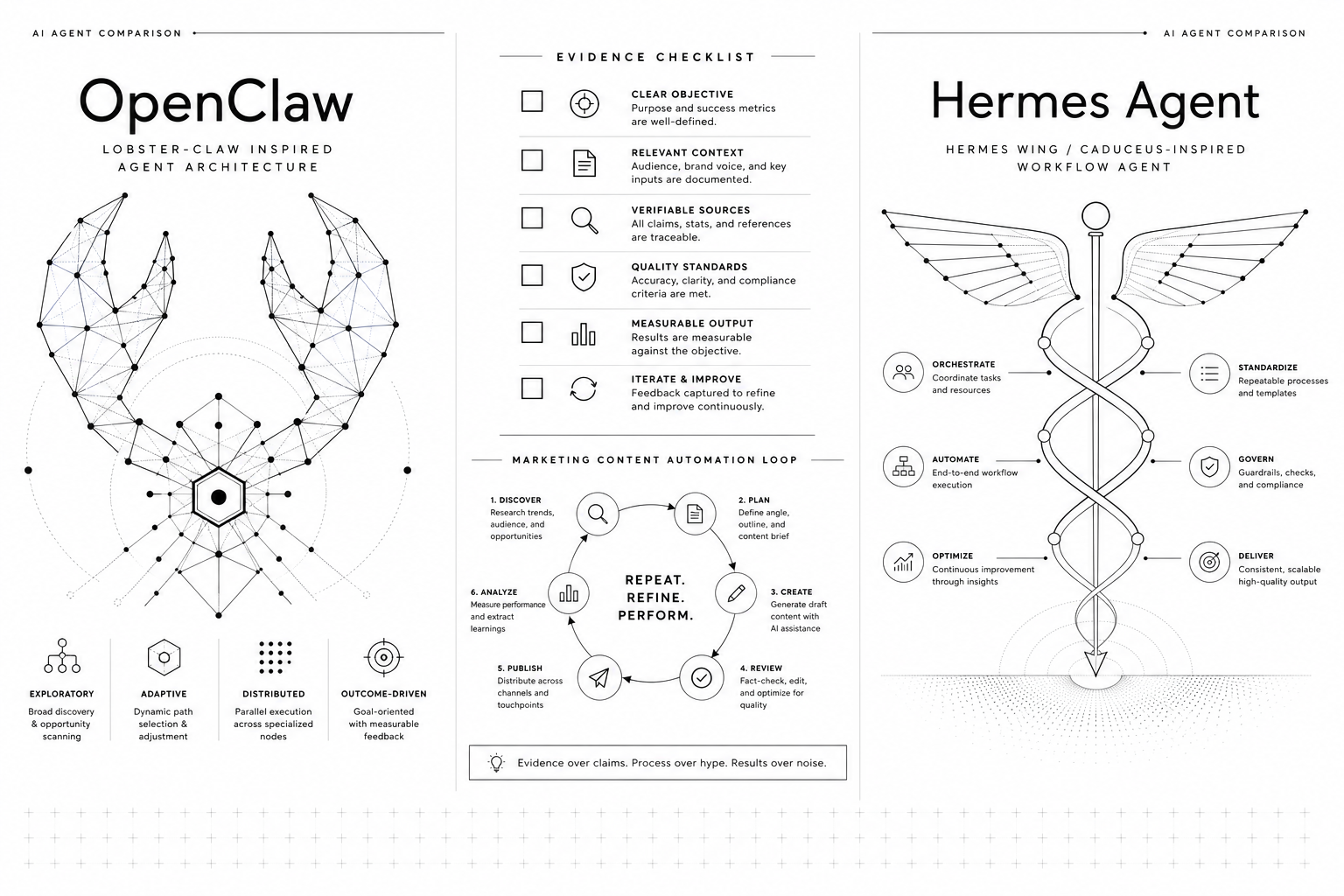
OpenClaw positions itself as a personal AI assistant that runs on your own devices. It emphasizes broad channel support (Telegram, Discord, WhatsApp, Slack, voice), a Canvas interface for visual work, and an onboarding flow designed for non-technical users. The README highlights "many channels" and "live Canvas" as core features. (OpenClaw GitHub)
Hermes Agent (by Nous Research) frames itself as a self-improving agent with bounded memory, a skill system, cron scheduling, and multi-provider LLM routing. The design leans toward developers and power users who want to build repeatable automated workflows. (Hermes Agent docs)
For marketing automation, the key distinction is:
- OpenClaw optimizes for breadth of interaction — talking to the agent from anywhere
- Hermes optimizes for depth of automation — building workflows that run without you
Feature comparison for marketing workflows
Content scheduling and cron
OpenClaw has a cron system that lets you schedule recurring tasks. However, public issue reports suggest reliability concerns with cron sessions. One user reported cron sessions fabricating operational output after tool failures — the agent continued producing plausible-looking results even when the underlying tools had failed silently.
Hermes Agent has a dedicated cron system with script gating, delivery targeting, and state management. Cron jobs can include pre-run scripts that decide whether the agent should execute at all, which prevents wasted runs. (Hermes cron docs)
For scheduled blog pipelines, the difference is significant: you need to trust that a scheduled job actually ran successfully, not just that it produced output.
Multi-channel distribution
Both tools support Telegram, Discord, and other messaging platforms. OpenClaw's channel support is broader out of the box, with voice and Canvas as additional interfaces.
Hermes focuses on programmatic delivery — you can target specific channels, threads, or chat IDs from cron jobs. The delivery model is designed for "push content to a channel" rather than "have a conversation."
For marketing distribution, the question is whether you need a conversational assistant that happens to post content (OpenClaw), or a content pipeline that happens to accept instructions via chat (Hermes).
Memory and context management
OpenClaw provides memory features that persist across sessions. However, one public issue reports memory bloat in heavy setups with crons, delegation, and gateway usage — the memory grew unbounded and degraded performance.
Hermes uses a bounded memory system with explicit write targets (user profile vs. agent notes) and a size limit. The skill system provides procedural memory that stays organized by task type. (Hermes memory docs)
For long-running marketing automation, bounded memory matters. You don't want the agent's context to degrade over months of scheduled runs.
Tool use and reliability
Both frameworks support tool calling — executing code, browsing the web, managing files. The difference shows up in failure handling.
OpenClaw has documented cases where tool calls were simulated rather than executed — the agent produced output that looked like it ran a tool but never actually called it. For marketing workflows that depend on real file operations, git commits, and API calls, this is a critical concern.
Hermes enforces tool execution through its runtime and reports actual tool output. The agent can't silently skip a tool call and produce fabricated results.
Real-world friction points
OpenClaw
- Provider routing regressions: Users reported model/provider regressions after upgrades, where the system switched providers unexpectedly.
- Memory growth: Heavy setups with multiple cron jobs and delegation chains can accumulate memory that slows the agent.
- Cron reliability: Scheduled jobs may produce output even when underlying tools fail, creating a false sense of success.
Hermes Agent
- Steeper learning curve: The skill system, profile management, and cron configuration require more upfront investment.
- Less polished chat UX: OpenClaw's Canvas and multi-channel onboarding are more polished for conversational use.
- Cross-framework compatibility: Users running both tools report friction when trying to coordinate between them.
Fit-for-use-case conclusion
Choose OpenClaw if:
- You want a conversational assistant that works across many channels
- Your marketing automation is mostly ad-hoc (ask the agent to do something, get a result)
- You value a polished chat experience over scheduling reliability
Choose Hermes Agent if:
- You need scheduled, repeatable marketing workflows (blog pipelines, content calendars, automated publishing)
- You need to trust that scheduled jobs actually succeed (not just produce output)
- You want to build multi-step workflows with script gating, delivery targeting, and bounded memory
- You're building automation that should run for months without manual intervention
Our take: For marketing automation at ADWERK, we use Hermes Agent. The scheduling reliability, bounded memory, and script-gated cron system matter more than channel breadth when you're running a content pipeline that publishes on schedule. OpenClaw is a strong choice for interactive marketing assistance — but for automated workflows that need to run without supervision, Hermes is the better fit.
Disclosure: This comparison is based on official documentation, public GitHub issues, and direct testing. Reddit community threads were not directly accessible during this comparison. All user-experience claims are linked to specific public issue threads.
DROP YOUR EMAIL BELOW TO GET
ADWERK PRIORITIES
The best source for AI-powered product photography tips, tutorials, guides and industry best practices. Join the ADWERK community!